inquiry
Leave Your Message

China Top 10 Arc Welding Robot Manufacturers?

China’s arc-welding robot industry brings together established automation groups and specialized manufacturers. Comparing the top ten is not simply a ranking exercise. Buyers need to examine what each supplier can deliver on the factory floor.

An Arc Welding Robot must do more than trace a programmed seam. It needs stable arc control, accurate torch positioning, and repeatable motion across changing workpieces. Consider a steel frame with tight corners, uneven joints, and visible spatter. Those details reveal more than a polished product photograph. Ask manufacturers for sample welds, cycle-time data, integration references, and clear service terms. Check whether their systems support the required welding process and fit existing fixtures. Small differences matter.

Welding engineer John Norrish has written extensively about welding technology. A practical summary of his field’s central lesson is: “Reliable weld quality depends on controlling the process, not just moving the torch.” This is an editorial paraphrase, not a verbatim quotation. It points to a common purchasing mistake: judging robot reach and payload while overlooking process setup, operator training, and maintenance support.

This guide compares ten Chinese manufacturers through practical criteria, including product range, customization, integration capability, and after-sales service. The available evidence may not be equally detailed for every company. That limitation deserves attention. Use the overview to build a shortlist, then verify claims directly with suppliers and request application-specific demonstrations before making a decision.
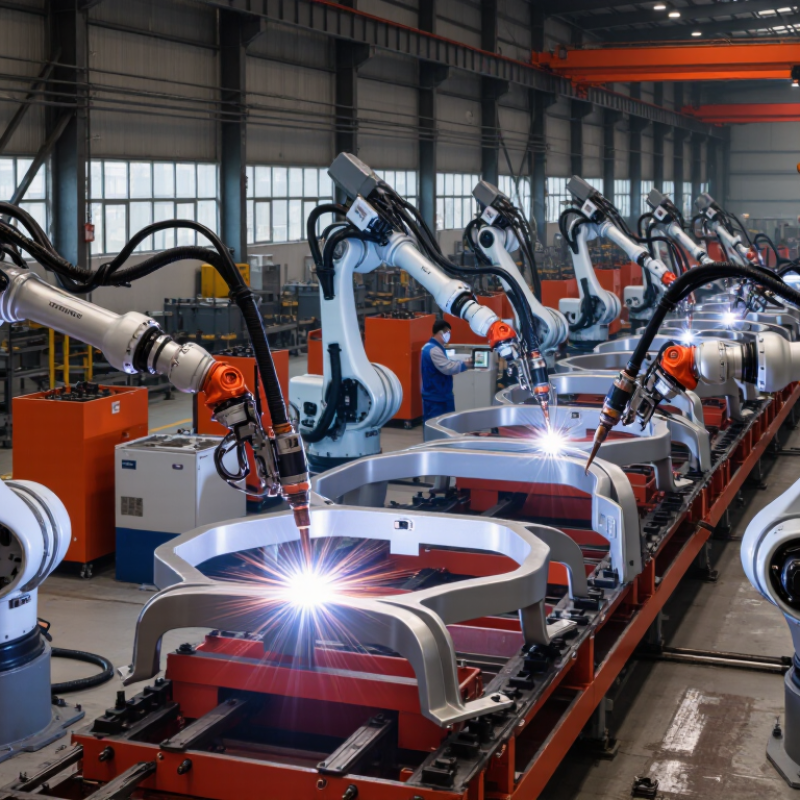
China Top 10 Arc Welding Robot Manufacturers?

What Defines a Leading Arc Welding Robot Manufacturer in China

China Top 10 Arc Welding Robot Manufacturers?

What Defines a Leading Arc Welding Robot Manufacturer in China

A leading arc welding robot manufacturer offers more than a robotic arm. It should understand torch angle, wire feeding, arc stability, and heat distortion. These details decide whether a weld survives production pressure. The International Federation of Robotics reported 276,288 industrial robot installations in China during 2023. China represented 51% of global installations that year. This scale raises expectations for local welding suppliers.

Strong manufacturers combine mechanical design with process engineering. They provide offline programming, seam tracking, adaptive welding, and clear maintenance records. Their systems should support common welding processes, including MIG, MAG, and TIG. Testing should cover repeatability, cycle time, spatter, and weld penetration. ISO 10218 safety practices also matter. A credible supplier shares measurable results, not only polished videos. The IFR’s World Robotics 2024 report is useful, but it does not measure arc-welding quality directly. That limitation deserves attention.

Tips: Ask for a sample weld using your actual steel, joint design, and wire. Check the bead profile under magnification. Request failure data, spare-parts lead times, and operator training records. A factory visit can reveal cable protection, fixture accuracy, and software usability. Do not judge quality from speed alone. Faster is not always better. A supplier may promise 24-hour support, yet practical response times can vary. Define service targets in writing, then review them after installation.
China’s Top 10 Arc Welding Robot Manufacturers by Core Capabilities

China Top 10 Arc Welding Robot Manufacturers?

China’s Top 10 Arc Welding Robot Manufacturers by Core Capabilities

A meaningful comparison of arc welding robot manufacturers should look beyond advertised speed. Core capability starts with stable motion, repeatable torch angles, and compatibility with common welding processes. Ask how a system handles long seams, tight corners, and changes in part position. Small details matter. A torch that drifts slightly can leave uneven beads across a production run.

Integration is another key measure. Check whether the robot, welding power source, positioner, and safety equipment work as one coordinated cell. Seam tracking can help when parts vary, but it cannot fix poor fixtures or inconsistent preparation. Ask for a sample weld using your material and joint design. Inspect bead shape, spatter, cycle time, and how easily operators can adjust settings. Training and local technical support also affect long-term performance. A fast machine is not always the best fit.

For a top-ten shortlist, compare working reach, payload, programming tools, process control, and service response using the same test parts. Request clear documentation and realistic cycle-time estimates. One limitation is easy to overlook: factory demonstrations may use cleaner parts than yours. Your own trial is more revealing. Even then, results can vary. Recheck them on a normal production shift.

Key Robot Types, Welding Processes, and Automation Solutions

Arc welding robots differ in reach, payload, and movement. Six-axis articulated robots handle curved seams and changing torch angles. Gantry systems suit long, straight welds on large structures. Collaborative units can support lower-volume work, but their use still requires a careful risk assessment. The best choice depends on part size, production rhythm, and access to the joint—not a headline speed figure.

MIG/MAG welding is common for thicker steel and continuous production. TIG offers cleaner control on thinner materials, though it is often slower. Spot welding fits sheet-metal assemblies with repeatable joint locations. No process fixes poor preparation. A small gap or oily surface can still cause defects.

A practical cell may combine a robot, a positioner, fixtures, and seam tracking. Positioners keep the joint within a useful torch angle; tracking can compensate for modest part variation. Sensors help, but they do not replace sound fixturing. Operators should review sample welds, inspect the heat-affected area, and check repeatability across shifts. Start with a representative part. Then adjust. Automation can improve consistency, yet setup quality remains a weak link—and sometimes the missed detail is simply an awkward cable route.

How to Compare Chinese Arc Welding Robot Manufacturers

Compare Chinese arc-welding robot manufacturers on the complete welding cell, not just the robot arm. IFR’s World Robotics 2024 report records 276,288 industrial robots installed in China in 2023, about 51% of global installations. That scale signals a deep supplier base, but it does not prove welding quality. MarketsandMarkets estimated the broader welding-robot market at USD 8.7 billion in 2023 and forecast USD 11.7 billion by 2028; this category includes more than arc-welding systems.

Request a live test using your material, wire, joint position, and production speed. Record cycle time, arc-on time, spatter, seam-tracking accuracy, and recovery after a simulated fault. Small details matter. Ask for evidence. Check whether the quoted package includes the power source, torch cleaning, safety equipment, programming, and local service. A polished demonstration can hide difficult changeovers. Compare sample welds and maintenance logs, then ask operators how long retraining takes after a product change. ISO 9283 offers useful robot performance test methods, but repeatability figures alone cannot predict weld quality. One weakness in this comparison is that factory trials take time; skipping them can make a low purchase price look more attractive than it really is.

China Top 10 Arc Welding Robot Manufacturers? – How to Compare Chinese Arc Welding Robot Manufacturers

Use this comparison framework to assess up to 10 suppliers. The benchmarks below are screening guidelines, not specifications or rankings for particular manufacturers. Confirm all values against the proposed robot, welding package, and application.

Comparison Dimension What to Compare Practical Screening Guide Evidence to Request
Robot reach and payload Reach, wrist payload, and allowable wrist moment for the torch, cables, and sensors. Match the robot to the workpiece and fixture layout; do not compare reach or payload without checking the load diagram and installed tooling mass. Robot datasheet, payload diagram, and reach study for the actual cell.
Repeatability and path performance Specified pose repeatability and demonstrated torch-path performance under the intended operating conditions. Compare figures stated under the same test standard and conditions; repeatability alone does not establish weld accuracy on a real part. Datasheet, applicable test method, and sample-path or sample-weld results.
Welding process compatibility Compatibility with the required process, such as GMAW/MIG/MAG, and the specified power source and wire feeder. Confirm the complete system supports the required material, wire, transfer mode, and parameter-control functions. Written compatibility list, interface details, and a process demonstration.
Seam finding and tracking Available touch sensing, through-arc sensing, or laser seam-tracking options, as appropriate to the application. Choose sensing based on joint type, part variation, access, and required correction; verify performance on representative parts. Option list, sensor specifications, and trial results using production-like samples.
Torch package and cable management Torch rating, neck access, cable routing, collision protection, and serviceability of consumables. Check clearances and cable motion across the full robot path, including fixtures and positioners. Torch and cable specifications, layout drawings, and a full-path simulation or test.
Cell safety and integration Risk assessment, safeguarding, emergency stops, interlocks, and integration with the cell controller. Assess the completed cell against applicable local regulations and relevant robot and machinery safety standards; a robot alone does not make a cell compliant. Safety concept, risk-assessment documentation, and system-level validation records.
Programming and operator usability Teaching workflow, offline programming options, language support, backups, and operator access controls. Have the intended operators complete a representative teach-and-edit task before selection. Hands-on demonstration, software documentation, and backup/restore procedure.
Production performance Cycle time, arc-on time, changeover time, weld quality, and rework for the same part and process. Compare results from a controlled sample-weld or acceptance test; cycle time depends on the whole cell, not just robot speed. Test protocol, measured cycle-time breakdown, weld inspection results, and agreed acceptance criteria.
Service and spare parts Local technical support, response arrangements, training, spare-part availability, and warranty scope. Compare written service commitments and total support coverage for the installation location. Service terms, spare-parts list, escalation contacts, and training plan.
Total cost and delivery scope Robot, welding equipment, fixtures, safety equipment, integration, commissioning, training, and ongoing consumables. Compare like-for-like quotations with clearly stated exclusions, delivery terms, and acceptance milestones. Itemized quotation, project schedule, scope matrix, and payment/acceptance terms.

Industry Applications and Future Trends in Robotic Arc Welding

China’s arc welding sector is shifting from repetitive production toward adaptive, data-driven fabrication. According to the International Federation of Robotics’ World Robotics 2024 report, China installed 276,288 industrial robots in 2023. This represented over half of global installations. Welding remains important in automotive, construction machinery, metal furniture, shipbuilding, and heavy equipment.

Modern arc welding robots use vision sensors, seam tracking, and real-time current control. These tools help manage warped plates, changing gaps, and inconsistent surfaces. The International Federation of Robotics also reported 541,302 industrial robot installations worldwide in 2023. This growing installed base supports stronger demand for integration, maintenance, and operator training. Future systems will likely connect welding cells with digital twins, predictive maintenance, and manufacturing execution software. Smaller factories may adopt collaborative robots, although payload limits and welding safety requirements remain practical obstacles.

Tips: Evaluate torch stability, seam-tracking accuracy, service response, and programming time before comparing the top ten manufacturers. Ask for measured results on your own materials. A polished demonstration can hide difficult joints. Energy monitoring also matters, because idle motion and repeated welds increase operating costs. The market is advancing quickly, but automation is not automatically efficient. Poor fixture design still causes defects, even with advanced software. Industry reports provide useful direction, yet factory-level testing remains more reliable than rankings alone.